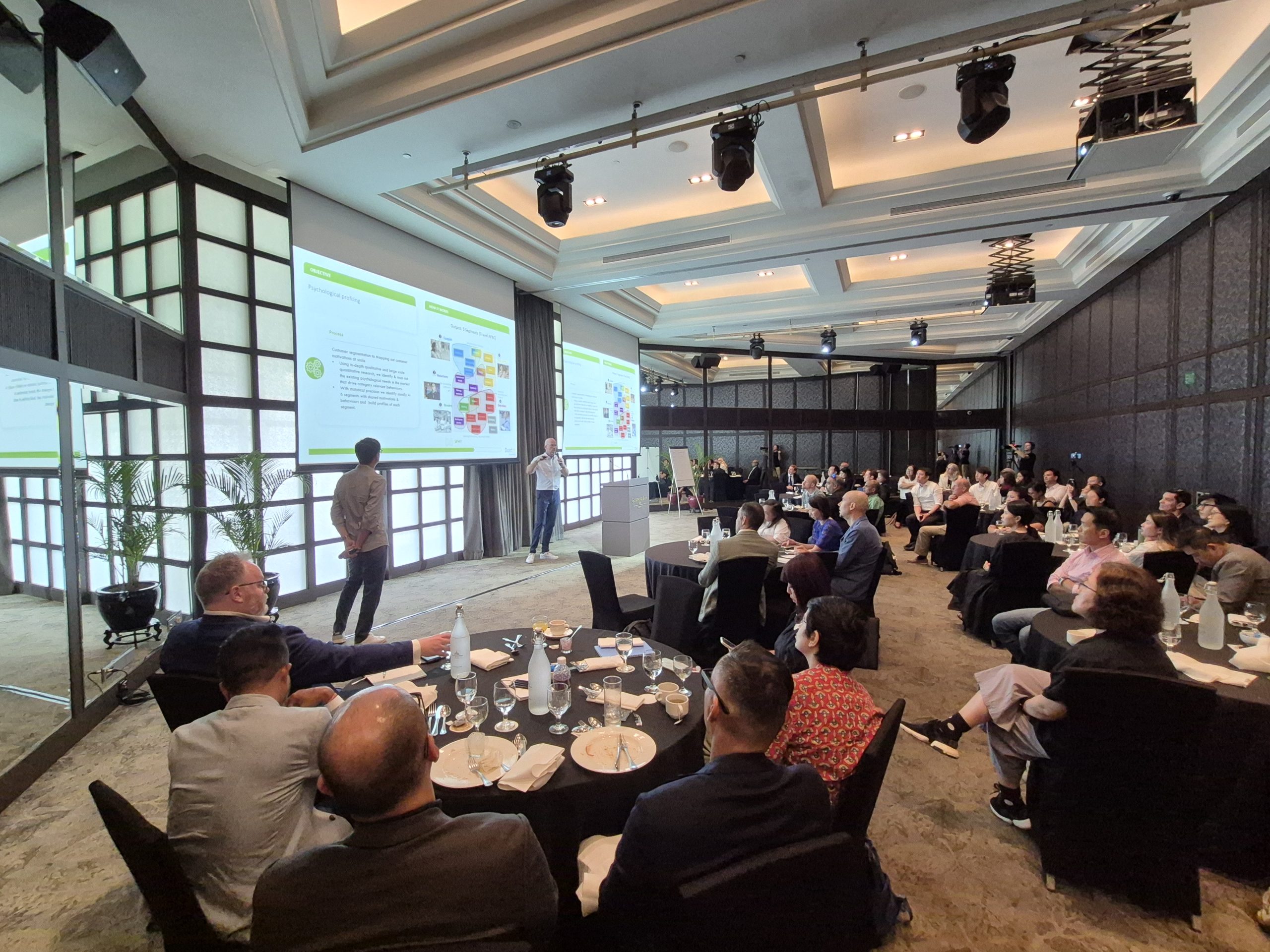
The Asia Research Seminar, Singapore
By: Piers Lee, Deputy Editor, Asia Research Media
Asia Research held its 19
th breakfast seminar in Singapore on 8
th May.
While most research and consumer insight events today focus on the applications and benefits of Artificial Intelligence (AI), this Asia Research event took a step back to consider, “The Bigger Picture.” The seminar explored the broader impact of AI on the industry, its limitations, and the evolving role of the human researcher.
A unique perspective came from outside the industry, presented by futurist Neil Mann from Future Horizons. Neil argued that although AI holds great potential, many organizations are rushing into adoption out of Fear of Missing Out (FOMO). This has led to over-investment in AI without sufficient consideration of return on investment (ROI) or even how to evaluate ROI. He likened this to “a hammer looking for a nail”: if a product doesn’t include AI, it often fails to generate interest, regardless of its actual value.
Neil also pointed out that many products claiming to use AI are, in fact, simply employing analytics or automation.
A Gartner study on the “hype cycle” of emerging technologies shows that generative AI is currently in the phase of “inflated expectations,” heading toward a “trough of disillusionment” a pattern seen with technologies like blockchain. Gartner reported that more than half of organizations are abandoning their AI initiatives due to misjudgements about costs. Similarly, a BSG study revealed that 74% of companies have yet to demonstrate tangible value from AI. A report in
The Economist echoed these concerns, noting that few AI start-ups are turning a profit due to increasing model and data constraints.
Despite these challenges, Neil maintained that AI can be highly beneficial when used under human oversight. He emphasized that AI should serve as an accelerator and amplifier—especially for processing large data sets, recognizing patterns, and identifying trends.
Neil concluded that AI would become part of our digital fabric and could be a transformative technology. He referenced Amara’s Law:
“We tend to overestimate the effect of a technology in the short run and underestimate the effect in the long run.”
Piers Lee, Managing Director from BDRC, presented findings from the Asia Research Stakeholder Survey, which examined the broader impact of AI on the consumer insight industry.
The Asia Research survey, conducted at the end of 2024, revealed that AI has been adopted more widely in consumer insight than other industries, partly due to its broad range of applications. Piers noted that the primary current uses of AI in the sector include desk research, brainstorming, automated transcription, and automated insight generation.
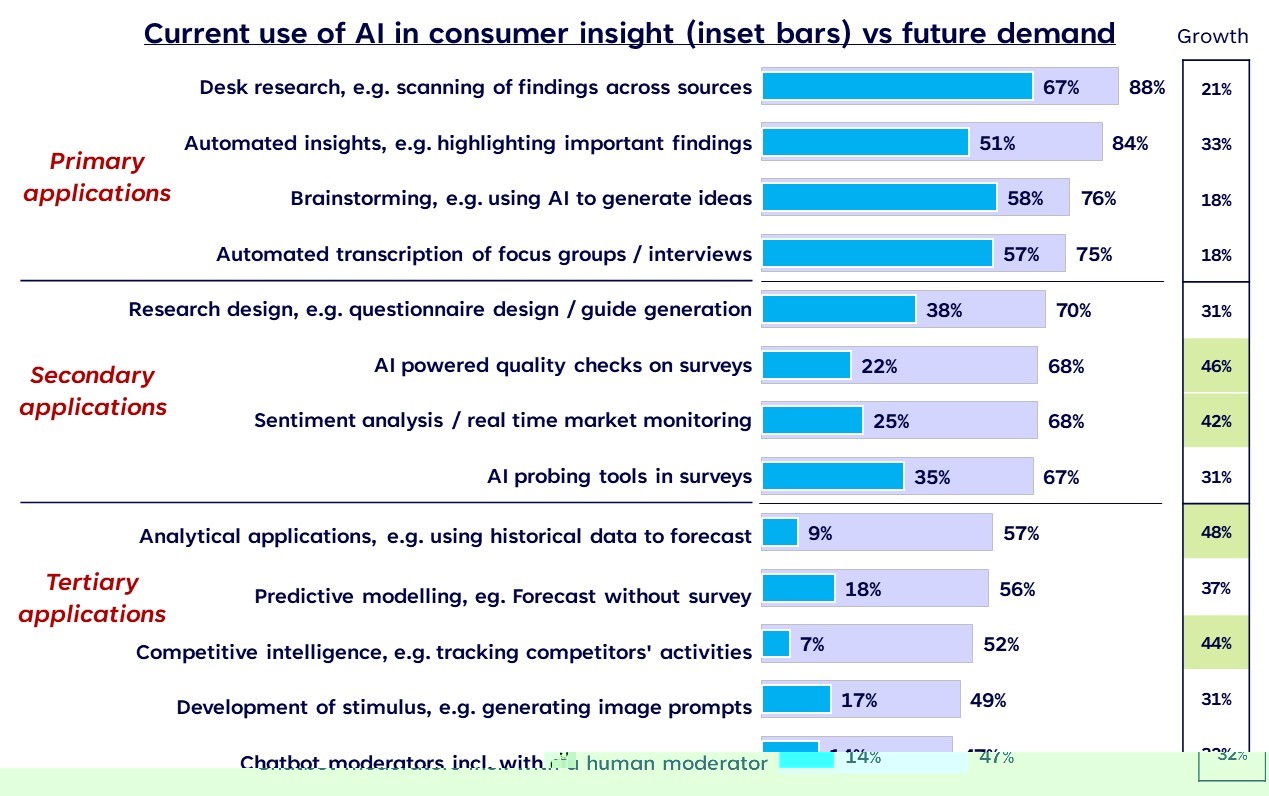
However, some of the fastest-growing areas involve more analytical applications, such as using historical data for forecasting, AI-powered quality checks, competitive intelligence, and real-time sentiment analysis.
Piers highlighted that research stakeholders perceive an almost equal balance of positive and negative outcomes from AI adoption in market research. He suggested that the industry could evolve into a more diverse ecosystem, where traditional market research agencies evolve to become one or a combination of several types of vendors. This may include leaner, consultancy-style firms with a higher ratio of senior to junior staff, hubs focused on AI-driven behavioural science insights, and specialists offering targeted applications in areas like media, advertising, and shopper research.
BoltChatAI delivered a joint presentation with Opella, the consumer healthcare division of Sanofi.
Lester Sualog from BoltChatAI shared findings from AI-assisted product innovation research conducted in collaboration with Opella. The study went beyond the limitations of traditional qualitative and quantitative methods. The use of agentic AI-driven conversations means that bot moderators no longer simply follow a fixed discussion guide instead, they dynamically guide conversations, using follow-up probes aligned with the overall objectives of the research.
Through this technology, consumer panels can be engaged for “qual at scale,” or clients can leverage their own customer base for similar studies. AI moderation involves two roles: an AI agentic moderator and a referee, who may remove participants that are not meaningfully contributing to the discussion. A key innovation is the ability to integrate and resurrect past data, enriching current research insights.
Percival Pastrana, Consumer Science Lead at Sanofi showcased a study in Japan that focused on a typical “red ocean” market, where consumers face an overwhelming array of choices and unclear messaging in the consumer healthcare space. BoltChatAI helped Opella triangulate consumer attitudes with actual behaviours, uncovering actionable insights that have informed innovation strategies and identified steps to help “decomplexify” this crowded category.
Laurenz Koehler and Eddie Shin from Duxton Consulting showcased their AI-powered approach to market segmentation.
In today’s digital landscape, Laurenz argued that traditional segmentation models have become less effective. To remain relevant, segmentation must become more actionable—especially in a world where brands can engage directly with consumers through digital channels. While machine learning has enabled micro-segmentation, it often lacks depth, such as understanding
who the customers are and
why they are engaging.
Traditional segmentation typically relies on historical behaviour and fails to provide the insights needed to influence future behaviour. In response, Duxton Consulting integrates multiple methodologies to uncover five key insights:
Who – Identifying the customer, their profile, etc.;
What – Understanding which promotions lead to engagement;
When – Determining when customers are ready to make a purchase;
Why – Exploring motivations: why customers choose your product over competitors, what drives them, and what makes them willing to pay a premium; and
How – Defining the optimal outreach methods, using a generative AI tool to craft messaging and evaluate campaign effectiveness.
By combining these elements, Duxton aims to deliver what they call the “perfect segmentation.”
Finally, aside from the presentations on AI, YouGov discussed how to ‘Build Brand Resilience’ in an era where brands are increasingly vulnerable to crises, often worsened by the rapid spread of negative word-of-mouth on social media.
Lyndon Tan highlighted that consumer boycotts can have a significant impact on both brand reputation and revenue. Common types of brand crises include data breaches, socio-political controversies, product recalls, unethical business practices, misleading advertising, and service outages.
He also pointed out that consumer concerns vary significantly by region. For example, while data breaches are the top concern in many markets, in Indonesia, issues related to product health, safety, and quality are more prominent.
Such events typically harm a wide range of brand metrics. One of the key early indicators is
buzz—the level of positive or negative brand impressions generated through media and public discourse. More than half of consumers say they will fact-check negative claims to verify their accuracy. However, metrics like recommendation and purchase intent often drop, and on average, it takes about two months for negative buzz to subside.
To manage these situations, brands must take a proactive approach by addressing consumer concerns transparently and keeping their audience informed. However, the appropriate response strategy will vary depending on the market and product category.
Asia Research’s first AI-focused seminar sparked strong buzz on social media, marking a bold new direction for the brand.
The event reflects a strategic shift by Asia Research Media to explore the intersection of AI and traditional consumer insight. A key challenge lies ahead: redefining the role of human researchers, reshaping the function of research agencies, and guiding the broader industry to adapt to this fast-moving transformation.
This article was first published in the Q2 2025 edition of Asia Research Media